

BALEK !
No app required.

The medina of Marrakech runs on wheelbarrows. Carrossas.
They come out of nowhere, scraping over cobblestones, threading between people. They carry everything: watermelons, suitcases, timber, eggs. The odd chicken coop. A wonderfully disorganized procession on wheels. You hear them before you see them. And always, that voice out front: “Balek!”
The “derbs”, those narrow twisting lanes, fold into each other like old roots. Cars don’t stand a chance. Only the carrossas keep going, finding their way to the discreet doors of riads tucked behind high walls. That is why you always find them waiting at the edge, where the tarmac gives out and the alleyways take over. The carrossa picks up exactly where the rest of the world leaves off. These days it is all organized. Regular rounds, steady networks, a system that works. But before, there was no system.
There were just men. Mostly old, stationed there since forever, or near enough. They waited without watches, knew the routines without writing anything down. They were simply there. Still. Time seemed to move at a different pace around them. I used to see them lying back on their carrossas, hands behind their heads. Djellaba hitched up, bare feet. Some asleep. Others just watching the world go by without really seeing it. Metallic naps. Faintly comic. Slightly theatrical.
We used the carrossas all the time. For grocery bags, for luggage, for anything too unwieldy to carry on foot. And often I would put Manon in one. My daughter. Very small. Level with hips, elbows, market baskets. At certain hours, crossing the souk with her was an expedition. The carrossa became a sort of moving fortress. She was perfectly at home in it. I was rather less so: the ingrained dirt looked like it had been there since the last century. At least.
Then one summer, it happened.
The city had slowed down. Long, easy days. We had time, space, and the urge to make something together. With our hands.
I went to find one of the drivers. I suggested borrowing his carrossa for two days. The first day we would clean it, sand it down, treat the rust. The second, we would paint it. Freely. Our way. I would cover his two days off. He said yes, with a smile. The carrossa came into our courtyard. And that is where it all started. Rags, gloves, tins of paint. A bucket of water that changed colour every hour. Manon laughed. So did I. The metal came back to life. In the end there were around thirty. Ours first, then those handed over to artists in residence. Each carrossa became a canvas. A pattern, a surprise, a splash of color. The object changed. Just like that.
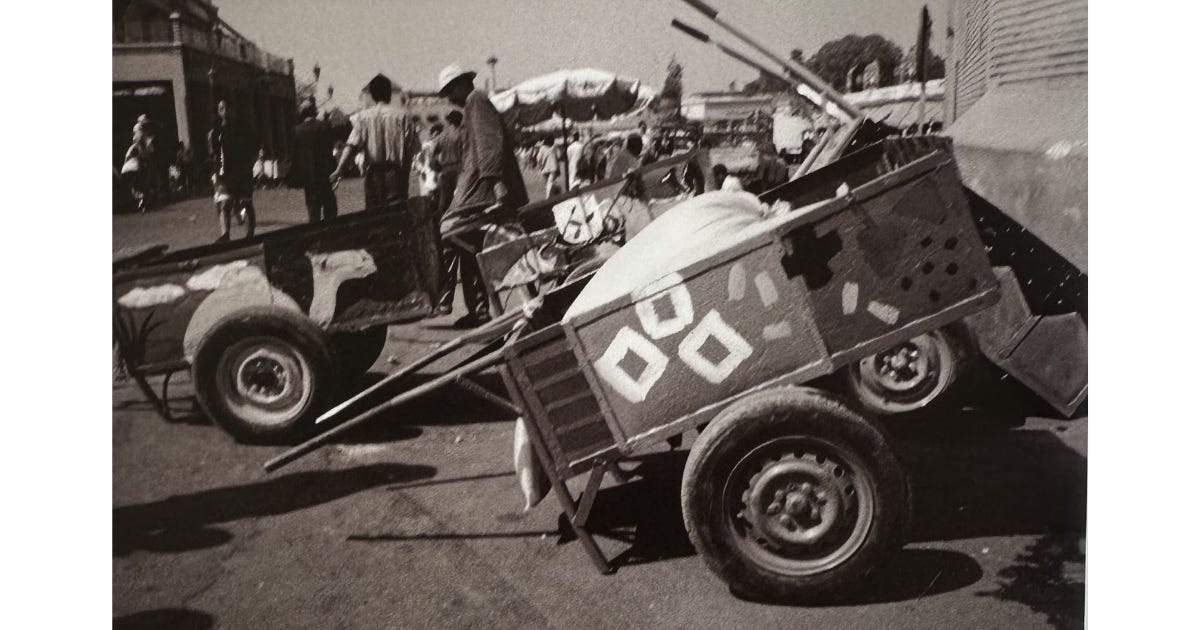
Then things began to shift. Heads turned. The painted carrossas caught the eye. They were asked for, chosen, picked over the plain ones. So the drivers started coming to us. Ringing at the door. Asking: “Can the fenaani, the artists, paint mine as well?”
One day, Manon spotted one of “her” carrossas making its way through the medina. She took my hand and said nothing. But I saw her face. She knew. That what we had done was beautiful. And that it was useful. Both things at once.
For a while, the medina changed color. The men, more noticed. More pride.
It was simple. Really simple.
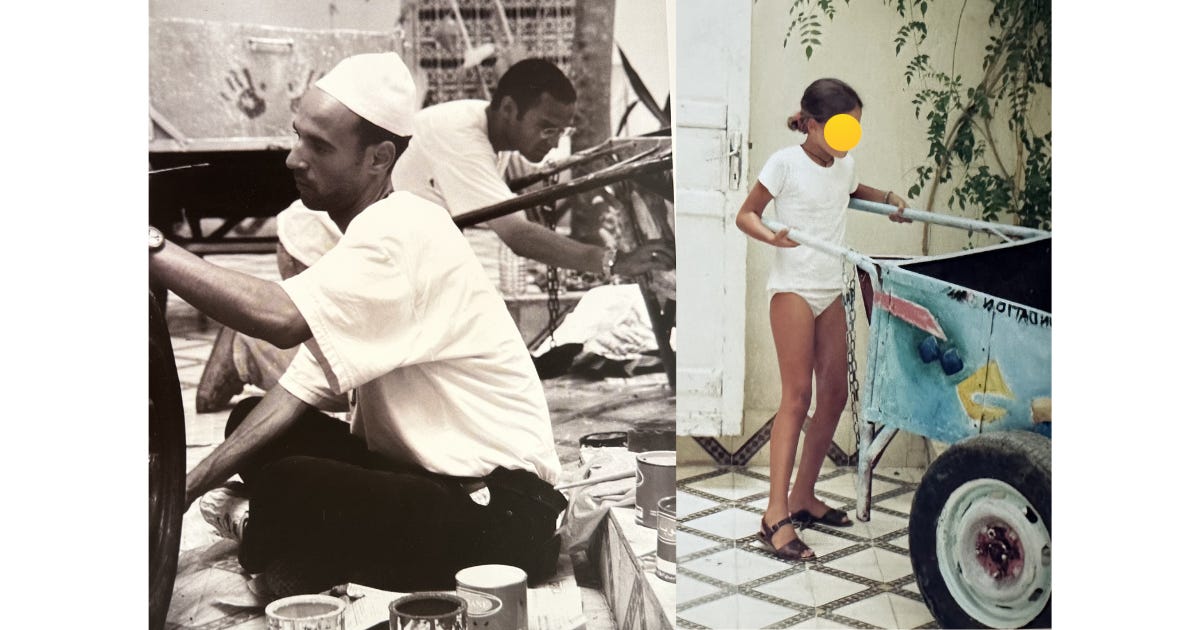
The story of a revival : same use but you add beauty to it! Amazing change that made the difference for their owners!
Congo has its Carrossas : les pousse-pousses ;-)
What a wonderful experience, teaching with the creative heart, for Manon.